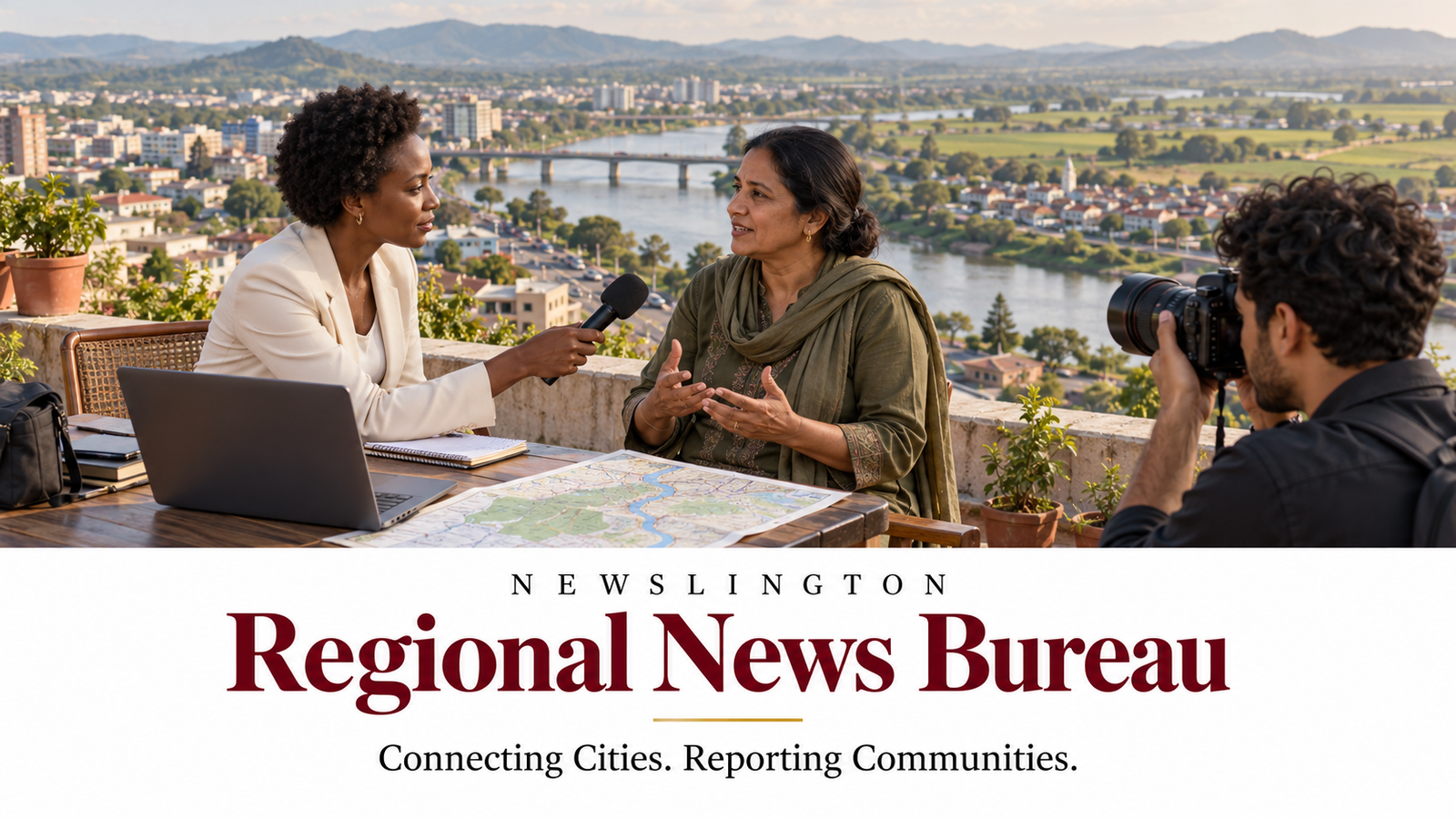
A region’s story rarely begins in one newsroom. It unfolds across cities, towns, universities, hospitals, markets, courts and communities. A transport development can affect several districts. A university discovery can influence businesses across an entire area. An environmental concern may connect communities that otherwise receive very different coverage.
A regional news bureau brings these developments into a shared editorial view. It helps readers understand the relationships between places while preserving the details that make each community distinct.
For Newslington™, this role belongs within a larger vision of journalism organized around location, knowledge and direct observation. Newslington is being designed to connect journalists through country networks, city networks, subject networks, bureaus and correspondents.
Its planned architecture includes more than 1,000 news networks across thousands of cities, with up to one million potential bureaus. These figures describe the ambition of a global journalism system in development.
Within that vision, a regional news bureau can connect reporting from neighbouring locations, identify stories with shared significance and help those stories reach appropriate national and international audiences.
What Is a Regional News Bureau?
A regional news bureau is a reporting operation focused on a defined geographic area containing multiple communities or locations. Depending on its editorial scope, that area might be a province, a group of cities, a wider domestic region or neighbouring countries.
Its purpose is to explain what is happening across that area and how individual developments relate to one another. Coverage can include business, public affairs, education, medicine, science, culture, technology, environment and everyday community life.
Regional reporting requires attention to both similarities and differences. Two cities may experience the same commercial trend but face different consequences. Communities sharing a transport route may have distinct priorities. A bureau should examine these relationships without presenting the region as a uniform population.
For Newslington, the regional news bureau is best understood through the wider principle of connected geographic and specialist reporting. Specific regional boundaries and operating arrangements would depend on its deployment model, which remains proprietary.
Why Regional Journalism Matters
Local reporting shows what happens in a particular place. National reporting addresses developments affecting a country. Regional journalism examines the connections that can fall between these perspectives.
A story may matter to several communities without becoming a national headline. Changes in education, healthcare access, trade, tourism or infrastructure can shape life across an area while receiving fragmented coverage.
A regional news bureau can bring those fragments together. It can follow developments across locations, compare experiences and explain why an issue deserves sustained attention.
This perspective also helps readers evaluate broad claims. An announcement may promise benefits throughout a region, but reporting from individual communities can reveal how implementation differs.
The value of regional journalism comes from examining the area closely enough to understand its internal relationships. A bureau becomes useful when its coverage helps people see beyond their immediate surroundings without losing sight of the circumstances in which they live and work.
Newslington’s Approach to Distributed Reporting
Newslington Networks™ is designed around a distributed reporting architecture. Its proposed networks are organized by country, city and subject, with journalists contributing from places where events actually happen.
This approach recognizes that valuable observations may come from people already present in a hospital, university, courtroom, market, stadium or conference. Journalism can begin with proximity, supported by the standards required to turn observation into reliable reporting.
For a regional news bureau, this creates a practical editorial possibility: contributions from different places can be examined together to build a fuller regional account.
A university journalist might document a research development. A business correspondent could examine its commercial relevance. Reporters in nearby cities could investigate whether similar activity is emerging elsewhere.
The public material describes the intended connections rather than a complete operational workflow. Its central proposition is clear, however: reporting should remain close to events while professional structures help connect the resulting work.
A city news bureau provides the detailed reporting that regional coverage needs. Cities contain institutions, cultural activity, industries, and public decisions for an area whose effects can extend into surrounding communities.
A regional news bureau benefits from journalists who understand those environments. They can identify relevant sources, follow developments over time and examine the practical consequences of announcements.
The relationship between city and regional reporting should preserve local detail. A development in one city may influence the region, but its consequences should be established through evidence rather than assumed.
City coverage can also reveal differences within a regional trend. Employment conditions, educational opportunities or business activity may develop unevenly across neighboring locations.
Within Newslington’s planned geographic structure, city reporting offers a foundation for this comparison. A regional perspective can then explain how individual stories connect, giving readers both the close view of a place and the broader view of its relationships.
A country news bureau provides national context for regional developments. It helps explain how events within a particular area relate to the country’s institutions, economy and public affairs.
A region may experience a national development differently from other parts of the country. Regional reporting can document those differences, while country-level coverage can explain the wider circumstances behind them.
This relationship strengthens both forms of journalism. National reporting becomes more representative when it includes evidence from different regions. Regional reporting becomes clearer when readers understand the broader decisions and conditions influencing local events.
Newslington’s proposed country networks create room for this connection. National identities named in its material include Pakistan News Network™, India News Network™, United States News Network™ and other country-focused concepts.
A regional news bureau can contribute depth to such coverage by showing how national developments unfold across actual communities, institutions and businesses.
Regional stories can also matter beyond a country’s borders. Trade, scientific research, culture, tourism, environmental developments and technology can connect a region with international audiences.
An international news bureau helps explain these connections to readers who may be unfamiliar with the places involved. Regional reporting supplies the detail needed to make that explanation accurate.
A story should establish its international relevance rather than rely on an ambitious headline. Journalists need to explain who is affected, what evidence supports the connection and which conclusions remain uncertain.
Newslington’s planned combination of geographic and subject networks provides a framework for identifying suitable audiences. A regional science development, for example, may interest specialist readers abroad while remaining rooted in reporting from a particular institution.
The regional news bureau’s contribution is to preserve that grounding as the story travels, helping wider audiences understand the development through its actual setting.
Understanding the Region Through Different Subjects
A regional news bureau needs an editorial view broad enough to reflect the area’s real activity. Public affairs are important, but they represent only part of regional life.
Newslington’s subject areas include business, finance, medicine, science, AI, technology, education, environment, sports, entertainment, fashion, travel, food, culture, entrepreneurship and local affairs.
These areas often overlap. A tourism story may involve employment, cultural preservation and transport. A medical development can raise questions about education, technology and public access. A business initiative may depend on research conducted nearby.
Connecting specialists with geographic reporters can improve coverage. Specialists help interpret evidence, while local journalists explain the setting and identify practical consequences.
For a regional news bureau, this combination supports a richer editorial picture. Readers can understand the area through its working institutions and communities, with enough expertise to explain developments that require more than surface observation.
Following Stories Across Multiple Locations
Regional coverage becomes particularly valuable when a story develops in several places. Separate reports may reveal a relationship that cannot be understood through a single location.
Consider a hypothetical transport project connecting three towns. One community may anticipate better access to employment. Another may be concerned about disruption. Businesses in the third may expect changes in customer activity.
A regional news bureau can investigate these experiences together. It can compare announcements with observations, examine relevant documents and identify questions that remain unanswered.
The same approach can apply to education, healthcare, commerce or environmental reporting. Comparison helps establish whether experiences are similar, different or too limited to support a broader conclusion.
This example illustrates the purpose of regional journalism rather than a specific Newslington assignment. The editorial principle is to connect evidence carefully, allowing the wider account to emerge from reporting rather than imposing a predetermined narrative.
Professional Identity Through the Newslington Passport™
Journalists contributing across locations and subjects need a way to connect their professional work. The Newslington Passport™ is designed to provide that continuity within the ecosystem.
Its proposed components include city, subjects, networks, stories, portfolio, education, reputation and integrity. Together, these elements are intended to connect a journalist’s activity across their professional life.
For a regional news bureau, such an identity could help organize contributions from reporters working in different settings. A journalist’s experience and published work would form part of a connected record.
Professional identity also supports attribution. Readers should be able to understand who produced a report and how that work relates to a wider body of journalism.
Identity does not establish accuracy on its own. Newslington’s emphasis on reputation and integrity recognizes that a professional record becomes meaningful through the quality of the work associated with it.
Earning Trust Through Consistent Reporting
A regional news bureau often reports on institutions and people its readers encounter directly. Its accuracy can therefore affect both public understanding and its own relationship with the community.
Newslington’s planned Journalist Integrity Index™ focuses on accuracy, evidence, ethics, transparency, professionalism, responsibility and integrity.
The underlying principle distinguishes access from trust. People may enter journalism quickly, but a dependable professional reputation develops through sustained conduct.
For regional reporting, this means checking information, representing sources fairly, acknowledging uncertainty and correcting mistakes. It also requires care when drawing conclusions from limited observations.
A report from one hospital does not automatically describe every hospital in the region. A business owner’s experience may be informative without representing an entire industry.
The proposed integrity framework emphasizes the standards through which readers can assess journalism over time. Its detailed scoring methodology is not provided, but its purpose is to make credibility something earned through observable professional practice.
AI Support for Organizing Regional Journalism
A regional news bureau can receive interviews, documents, photographs, recordings and reports from many locations. Organizing this material is an important part of editorial work.
Newslington is being designed with AI at its operating core. Its intended functions include classification, translation, transcription, discovery, verification support, organization, routing and personalization.
These capabilities could help connect contributions by location or subject. Transcription can make interviews easier to review. Translation can assist communication across languages. Classification can help journalists find related material.
Human review remains essential. An automated transcript may mishear a place name. A translation may miss context. Similar reports may concern different circumstances despite sharing vocabulary.
For a regional news bureau, AI should help journalists examine information and manage their work. Editorial decisions still require people to assess evidence, identify limitations and take responsibility for what audiences receive.
Regional Video Coverage Through Newslington Channels™
Regional journalism can be communicated through interviews, documentaries, video reports, explainers, bulletins and live coverage as well as written articles.
Newslington Channels™ is conceived as the broadcast and live layer of the wider system. Its planned channels are organized by country, city and subject.
A regional news bureau could bring audiovisual contributions together to explain developments across an area. A recorded interview might add personal experience to an explanatory report. Footage from several locations could help demonstrate the differences within a regional story.
Video requires the same editorial discipline as writing. A scene needs accurate identification and appropriate context. Images can establish what was visible without necessarily proving the explanation attached to them.
Newslington’s material applies verification, attribution, correction and integrity principles to broadcast work. The intention is recognizable professional journalism across formats, supported by consistent responsibility.
A Community for Regional Journalists
Reporting can be demanding, particularly when journalists work across dispersed locations. Professional relationships provide opportunities to exchange knowledge, seek advice and develop skills.
The Newslington Press Club and Cafe™ is designed as a professional and social home in physical and digital forms.
Its concept includes city chapters, briefings, interview spaces, recording facilities, mentoring circles, events and visiting-journalist access connected through the Newslington Passport™.
For a regional news bureau, this proposed community could help journalists maintain relationships beyond their immediate assignments. Reporters from different cities could compare experiences, while specialists could help colleagues understand unfamiliar subjects.
Mentoring also supports continuity within the profession. Experienced journalists can help newer contributors develop interview techniques, assess evidence and improve clarity.
Professional discussion does not replace verification. It strengthens the environment in which responsible reporting can happen by making informed questions and constructive scrutiny more accessible.
The Journalism Chamber of Commerce and Industry™
A regional news bureau is also an organization that needs sustainable professional and commercial relationships. Newslington addresses this dimension through the proposed Journalism Chamber of Commerce and Industry™.
The Chamber is intended to connect journalists, journalism companies, institutions, advertisers, technology providers and governments. Its planned areas include membership and accreditation, business standards, partnerships, representation, delegations and market access.
For regional journalism, this industry perspective recognizes that a bureau requires an economic foundation alongside its editorial mission.
Commercial relationships need transparency and appropriate boundaries. A partnership cannot serve as evidence for a report, and an advertiser’s preferences should not determine its conclusions.
The Chamber belongs to the Newslington Journalism Economy™, which treats journalism as a profession capable of supporting enterprise. A regional bureau’s public value must continue to depend on the reliability and independence of its reporting.
Education for Better Regional Reporting
A regional news bureau needs journalists who can adapt to changing tools while maintaining clear standards. Newslington’s proposed institutes address both professional capability and public responsibility.
The Institute of Disruptive Journalism™ focuses on AI, technology, verification, multimedia production, audience development, entrepreneurial journalism and future skills.
Its intended approach is to help journalists use new methods thoughtfully. Learning a tool includes understanding where it can assist and where its output requires further examination.
The Institute of Public Journalism™ focuses on evidence, attribution, corrections, conflicts of interest, source handling, manipulated media, AI disclosure and the distinction between reporting and opinion.
These subjects matter when journalists cover familiar communities. Access and relationships can provide insight, but they can also create assumptions that deserve scrutiny.
Together, the institutes are intended to support journalism that combines technical competence with accountable professional conduct.
Equipment and Practical Support
A regional news bureau depends on working tools: cameras, microphones, recorders, laptops, storage, batteries and equipment suited to its assignments.
Journalism Supplies & Stores™ is designed as a dedicated supply network and online marketplace for the profession. Its concept includes reporting, photography, broadcasting, studio and field-safety equipment, with servicing, rental and replacement among the intended provisions.
Practical preparation affects the quality of reporting. Reliable audio supports accurate interview review. Appropriate storage helps preserve records. Suitable equipment allows journalists to document events more effectively.
Newslington also invites Partner Organizations to provide privileges and special discounts for Passport holders. Particular benefits depend on participating organizations and their arrangements.
The broader proposition is that journalism needs material support alongside editorial ambition. A regional news bureau works more consistently when its people can access suitable tools and maintain them.
Building a Regional Journalism Institution
A bureau’s long-term strength depends partly on the organization behind its reporting. Clear responsibilities, financial discipline and continuity can help preserve professional work through change.
The Institute of Public Companies™ is intended to address governance, ownership, disclosure, capital readiness, succession and operational systems.
These concerns become more significant as a regional news bureau expands. An operation serving several locations needs structures that extend beyond one person’s daily involvement.
Newslington’s vision includes journalists building bureaus, agencies, networks, channels and production companies. Those enterprises require business knowledge alongside editorial ability.
The objective is institutional durability: preserving standards, retaining knowledge and supporting accountable leadership as the organization develops.
The supplied material does not establish regional bureau prices, licensing conditions or territorial exclusivity. Readers considering a commercial arrangement should obtain its specific terms directly from Newslington rather than infer them from the wider institutional vision.
Capital and the Journalism Stock Exchange™ Concept
The Journalism Stock Exchange™ is conceived as the capital layer of the Newslington Journalism Economy™.
Its proposed purpose is to create a marketplace where journalism enterprises, including bureaus, agencies, networks and production companies, can be valued, financed and developed.
The material connects participation with disclosure, transparent ownership, published standards, editorial independence and integrity ratings.
For a regional news bureau, the relevance is the recognition that valuable reporting needs an enterprise capable of supporting it financially. Continuity becomes difficult when resources depend entirely on immediate circumstances or one owner’s involvement.
The Stock Exchange remains a stated concept in the supplied document. Operational listing procedures, financing availability and investment outcomes are not specified.
Its place within Newslington’s vision is to connect enterprise development with transparency and discipline, so that the business supporting journalism can become more durable.
Frequently Asked Questions
What is a regional news bureau?
A regional news bureau is a reporting operation covering a defined area containing multiple communities or locations. It explains developments across that area and the relationships between them.
How is it different from a city news bureau?
A city news bureau concentrates on one city. A regional news bureau examines a wider area, connecting reporting from several places while preserving their individual circumstances.
Can regional stories reach international audiences?
Yes. Regional developments in subjects such as science, business, culture and technology can have wider relevance. That relevance should be established through evidence and clear explanation.
How does regional reporting fit into Newslington?
It aligns with Newslington’s planned connection of country networks, city networks, subject networks, bureaus and correspondents. Specific operating arrangements depend on its deployment model.
Is Newslington’s full network already operational?
Newslington describes a journalism system in development. Its figures for networks and potential bureaus express planned scale.
What is the Newslington Passport™?
It is designed to connect a journalist’s location, subjects, networks, stories, portfolio, education, reputation and integrity across the ecosystem.
How will AI assist a regional news bureau?
Planned functions include transcription, translation, classification and organization. Journalists remain responsible for reviewing information and making editorial decisions.
Are regional bureau commercial terms included?
No specific prices, licensing conditions, exclusive territories or guaranteed returns are provided in the supplied material.
Is the Newslington Dashboard™ publicly available?
The document states that the dashboard is under beta testing and is not publicly available through the website.
How can interested readers contact Newslington?
Journalism, partnership and founding-circle inquiries can be sent to newsroom@newslington.com.
Conclusion
A regional news bureau helps readers understand the connections between places. It brings together local observation, specialist knowledge and wider context to explain developments affecting an entire area.
Newslington places this work within a proposed journalism economy connecting networks, professional identity, integrity, education, community, equipment and enterprise.
The strength of regional coverage lies in its ability to see relationships without erasing differences. A useful bureau can follow a shared issue across several communities while allowing each community’s experience to remain visible.
Explore Newslington to learn more about its vision for journalism organized around where people are, what they know and what they witness.